
Online Video Counselling Australia | The Lotus Rooms Croydon

Updated: Sep 27
Last updated: September 2026
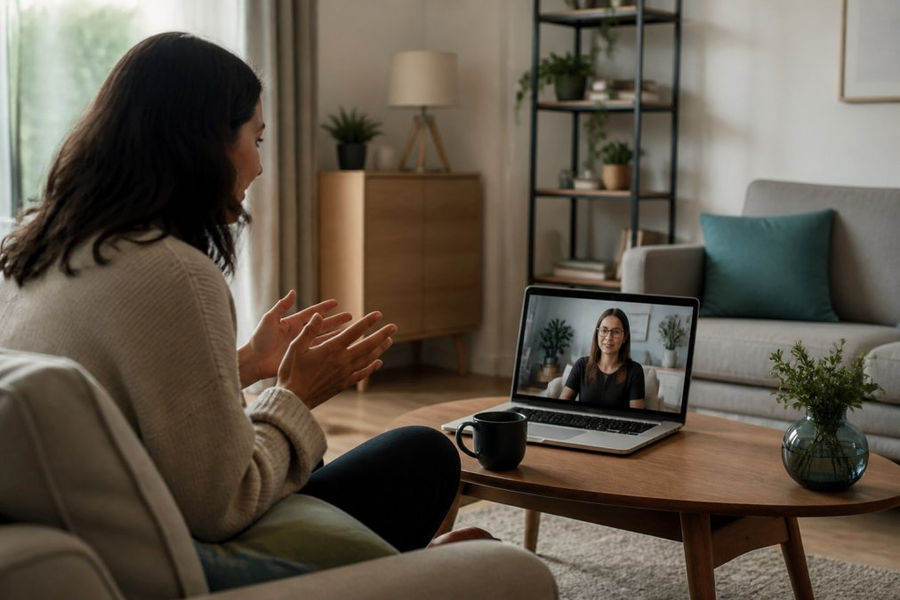
Online counselling has become an established way of accessing mental health and relationship support. Rather than travelling to a counselling room, clients can meet with their counsellor by secure video from a private location that suits them.
For some people, online counselling is primarily about convenience. For others, it can remove genuine barriers to accessing support, including distance, mobility difficulties, work commitments, family responsibilities and limited access to a particular practitioner.
At The Lotus Rooms, video conferencing is available when face-to-face counselling is not practical. The practice provides counselling from Croydon, Victoria, as well as video conferencing for clients who cannot attend in person.
The important question is not whether online counselling is universally "better" than face-to-face therapy. It is whether video counselling is an appropriate format for your circumstances, needs and therapeutic goals.
Table of Contents
What Is Online Video Counselling?
How Video Counselling Improves Access
Overcoming distance and mobility barriers
Fitting counselling around work and family
Privacy, Comfort and Control During Online Counselling
Is Online Counselling Effective?
What the research tells us
The importance of the therapeutic relationship
What can be different on video
Online Counselling vs Face-to-Face Counselling
When face-to-face counselling may be preferable
When video counselling may be particularly useful
How to Prepare for an Online Counselling Session
Creating a private environment
Checking your technology
What to do if the connection drops
Frequently Asked Questions
Online Counselling with The Lotus Rooms
What Is Online Video Counselling?
Online video counselling is a form of counselling delivered remotely using video communication technology.
Instead of travelling to a counselling practice, you communicate with your counsellor through a computer, tablet or smartphone. The session can generally follow many of the same conversational and therapeutic processes used during a face-to-face appointment.
Telehealth is now an established part of Australia's healthcare system. The Australian Institute of Health and Welfare describes telehealth as healthcare delivered by telephone or video and notes that telehealth services have been incorporated into Australian healthcare on an ongoing basis.
The Australian Government also recognises video consultations as a way eligible patients can access mental health services under the Better Access initiative, subject to the relevant Medicare requirements.
For clients, the practical difference is simple: the counselling session comes to you rather than requiring you to travel to the counsellor.
How Video Counselling Improves Access
One of the strongest advantages of online counselling is accessibility.
Travelling to an appointment can involve much more than the counselling session itself. Depending on where someone lives, an appointment may require driving, public transport, parking, arranging childcare, taking time away from work or organising assistance with mobility.
Video counselling can reduce some of these practical barriers.
The AIHW identifies accessibility, service availability, waiting times, cost and other practical factors as important influences on people's ability to access healthcare. For people with disability, for example, physical accessibility and availability of services can present significant challenges.
Overcoming Distance and Mobility Barriers
Geographical distance can make regular counselling difficult.
Someone living outside metropolitan Melbourne may have fewer local counselling options, while someone with mobility limitations may find travelling to an appointment physically demanding.
Online counselling can provide another option by removing the need to travel to the counselling room.
This can be particularly useful for people who:
live a considerable distance from their preferred counsellor
have mobility difficulties
find travelling physically tiring
have limited access to transport
are temporarily unable to travel
are travelling or living away from their usual location
prefer to receive counselling from a familiar private environment.
Video counselling does not eliminate every access barrier, but for some people it can make regular appointments considerably more practical.
Fitting Counselling Around Work, Study and Family
Modern schedules can make regular appointments difficult.
Work, university, school commitments, parenting and family responsibilities can all compete for the same limited hours.
A face-to-face appointment may require additional travel time before and after the session. With online counselling, that travel component can be removed.
For some clients, this means an appointment can fit more easily into an otherwise busy day.
The benefit is not simply saving time. Consistency is an important practical consideration in counselling. If a particular format makes it easier for you to attend appointments regularly, that may be relevant when deciding between online and face-to-face sessions.
However, convenience should not be the only consideration. The format also needs to provide an environment in which you feel comfortable, private and able to engage with the counselling process.
Privacy, Comfort and Control During Online Counselling
One of the distinctive features of video counselling is that the client chooses the environment in which the session takes place.
You may prefer to sit in a quiet room at home rather than travel to a counselling practice.
Some people find this environment reassuring. Others prefer the physical separation of entering a dedicated counselling room.
Both responses are completely understandable.
Privacy is particularly important with online counselling. Health information is sensitive information, and Australian privacy law can apply to organisations providing online counselling and telehealth services. The Office of the Australian Information Commissioner specifically identifies online health services, counselling and telehealth businesses among health service providers that may be covered by the Privacy Act.
For this reason, it is worth considering not only the technology being used by the provider, but also your own surroundings.
Before your session:
Choose a private room where you will not be overheard.
Close the door if possible.
Consider using headphones.
Avoid public spaces where conversations can be heard.
Make sure other household members understand that you need privacy.
Use a device that is protected by a password or other appropriate security measures.
Check the provider's privacy information if you have questions about how your information is handled.
The security of a video counselling session involves both the technology used by the provider and the environment in which the client participates.
Is Online Counselling Effective?
A common question is whether counselling delivered by video can work as well as counselling delivered face-to-face.
The answer depends on the type of therapy, the individual, the presenting concern, the practitioner and the quality of the therapeutic relationship.
Research into teletherapy has found that a therapeutic alliance can be established through remote therapy, and a systematic review and meta-analysis involving 4,862 participants found a statistically significant relationship between therapeutic alliance and treatment outcomes in teletherapy. The researchers also noted that the area remains under-researched and that results vary between studies.
This is important because successful counselling is not simply about sitting in the same physical room.
The quality of communication, the therapeutic relationship, the appropriateness of the intervention and the client's engagement all matter.
At the same time, it would be inaccurate to suggest that video counselling is identical to face-to-face counselling in every circumstance.
What the Research Tells Us
The evidence base for teletherapy has grown considerably, particularly for structured psychological interventions delivered remotely.
For many common mental health concerns, online psychological interventions can be an appropriate treatment format when they are delivered by an appropriately qualified practitioner and when the client is suitable for remote care.
However, evidence should not be interpreted as meaning that every person, every condition and every counselling approach is equally suitable for video delivery.
Some situations require additional clinical assessment, greater support or a different level of care.
For people experiencing an immediate mental health crisis or who may be at risk of harming themselves or someone else, online counselling should not be treated as a substitute for emergency or crisis services.
The Importance of the Therapeutic Relationship
The relationship between counsellor and client is central to counselling.
A useful therapeutic relationship involves trust, communication, safety, respect and a shared understanding of the work being undertaken.
Research into teletherapy has specifically examined the relationship between therapeutic alliance and treatment outcomes. The evidence suggests that the therapeutic relationship remains relevant in remote therapy, although researchers also identify important differences and limitations in the evidence base.
For some clients, communicating through video feels natural.
For others, it takes time to become comfortable with the format.
It is therefore reasonable to assess online counselling based not simply on whether the technology works, but on whether you feel able to communicate openly and productively with your counsellor through that technology.
What Can Be Different on Video?
Video counselling does not reproduce every aspect of a face-to-face interaction.
The visual field is more limited, for example, and technology can affect the rhythm of conversation.
Several differences may be noticeable.
Non-verbal communication
A counsellor can observe facial expressions and some body language, but the camera may not show the person's full posture or movements.
This means some non-verbal information available in a counselling room may be less visible online.
Silences
Silence can feel slightly different through a screen.
A pause may occasionally be affected by internet latency or the awareness that both people are looking at a screen. Over time, most people become more accustomed to the format.
Distractions
At home, there may be phones, family members, pets, household tasks or other interruptions.
For some clients, this is manageable. For others, the counselling room provides a valuable separation from everyday distractions.
The physical environment
The environment in which counselling occurs can influence how you experience a session.
Some people feel safer and more comfortable in familiar surroundings. Others find it easier to focus when they physically leave their home.
There is no universal answer.
Online Counselling vs Face-to-Face Counselling
The choice between online and face-to-face counselling is best considered on an individual basis.
Face-to-face counselling may suit you if:
you prefer a dedicated counselling environment
you find screens distracting
you communicate more comfortably in person
you want physical separation between home and counselling
your circumstances make remote counselling unsuitable.
Video counselling may suit you if:
travelling to appointments is difficult
you live some distance from your counsellor
work or family commitments make travel difficult
you have mobility limitations
you prefer the privacy of your own environment
you are temporarily unable to attend in person
you simply communicate comfortably through video.
Some people may also prefer flexibility between the two formats where their practitioner offers both.
The important question is not which format is theoretically superior. It is which format provides an appropriate setting for your counselling needs.
How to Prepare for an Online Counselling Session
A little preparation can make an online counselling appointment considerably smoother.
Create a Private Environment
Before the appointment, choose somewhere you can speak without being overheard.
Ideally:
close the door
tell other people in the household that you need privacy
use headphones if appropriate
turn off unnecessary notifications
place your phone on silent
avoid public areas
make sure you are unlikely to be interrupted.
If privacy at home is difficult, discuss possible alternatives with your counsellor.
Check Your Technology
You do not necessarily need sophisticated equipment.
A smartphone, tablet or computer with a camera, microphone and reliable internet connection may be sufficient, depending on the platform being used.
Before your first appointment:
Check your internet connection.
Test your camera.
Test your microphone.
Check that your speakers or headphones work.
Position the camera so your face is clearly visible.
Make sure your device is adequately charged or connected to power.
Close unnecessary applications.
Have your counsellor's contact details available.
It is also sensible to have an alternative way of contacting your counsellor if the video connection fails.
What If the Video Connection Drops?
Technology occasionally fails.
A poor internet connection, device problem or software issue does not necessarily mean the counselling session needs to end.
Before your appointment, establish with your counsellor what should happen if the connection is interrupted.
For example, you might agree to:
reconnect using the same video link
wait a few minutes and try again
contact each other by telephone if necessary
reschedule if the technical problem cannot be resolved.
Having a backup plan can prevent a technical problem from becoming an unnecessary source of stress.
Frequently Asked Questions About Online Video Counselling
Is online counselling as effective as face-to-face counselling?
Online counselling can be an effective way of delivering psychological and counselling support for many people, and research has demonstrated that therapeutic relationships can be established through teletherapy. However, outcomes depend on the individual, the presenting issue, the therapeutic approach and the quality of the professional relationship.
It is therefore more accurate to say that video counselling is an established therapeutic format rather than claiming that it is automatically equivalent for every person and every situation.
What technology do I need for online counselling?
Usually, you need a computer, tablet or smartphone with a camera and microphone, together with a reliable internet connection.
Headphones can be useful for improving privacy and reducing background noise.
Your counsellor should provide information about the video platform and how to connect to your appointment.
Can I do counselling from home?
Yes. Home is one of the most common environments for online counselling.
The most important consideration is privacy. Try to find a room where you will not be interrupted or overheard.
Is video counselling private?
Health and counselling information is sensitive, and Australian privacy requirements can apply to online counselling and telehealth providers.
However, privacy is a shared responsibility. Your counsellor should use appropriate systems and procedures, while you should also consider the privacy of your own environment.
Ask your counsellor about their privacy practices if you have concerns.
Can relationship counselling be conducted online?
Yes. Relationship counselling and couples counselling can be conducted through video conferencing when the practitioner considers the format appropriate.
Online sessions can allow partners to participate even when travelling or when attending the same physical location is difficult.
The suitability of online relationship counselling depends on the circumstances of the couple and the issues being addressed.
Can I access counselling if I don't live near Croydon?
The Lotus Rooms provides face-to-face counselling from Croydon and also offers worldwide video conferencing when face-to-face attendance is not possible. The practice's website specifically instructs clients booking online to indicate "Video Conference" in the booking message.
This can provide an alternative for clients who cannot conveniently attend the Croydon practice.
Online Counselling with The Lotus Rooms
The Lotus Rooms provides counselling from Croydon, Victoria, with online video conferencing available when face-to-face counselling is not practical.
Services listed by The Lotus Rooms include individual counselling, relationship and marriage counselling, family counselling, anxiety and depression support, stress, grief and loss, anger management and other areas of personal development.
The practice describes its approach as solution-focused and holistic, with an emphasis on understanding thoughts and emotions and identifying practical changes that may support personal wellbeing.
For clients considering online counselling, the process is straightforward: select an available appointment and indicate that you would like the appointment conducted by video conference. The current booking information states that counselling sessions are approximately one hour, with the listed standard fee of $90 per session and concessions available for eligible clients.
Book an Online Counselling Appointment
If you believe online counselling could be a suitable option for you, you can contact The Lotus Rooms to discuss your circumstances and arrange an appointment.
The Lotus Rooms Suite 1/174 Main StreetCroydon VIC 3136
For online bookings, select an appointment and indicate "Video Conference" in the booking message.
Important: Online counselling is not an emergency service. If you or someone else is in immediate danger, contact emergency services or an appropriate crisis service rather than waiting for a counselling appointment.
Final Thoughts
Online video counselling is no longer simply a substitute for an appointment that cannot happen in person. For many people, it is a practical way of accessing counselling that fits more easily around distance, mobility, work and family responsibilities.
At the same time, video counselling is not the right format for everyone.
The best choice depends on your circumstances, the nature of the concerns you want to address, your comfort with technology and the relationship you establish with your counsellor.
Whether counselling takes place in a room or through a screen, the goal remains the same: creating a professional, respectful environment in which you can explore difficulties, develop greater understanding and work towards meaningful change.
Book Online: www.thelotusrooms.com/fees


Hope you enjoyed this article. PLease feel free to ask any questions here or by email.